Capturing Scholarship: Electronic Theses and Dissertations in the DRS
Northeastern’s electronic theses and dissertations (ETDs) provide a valuable record of the university’s scholarly contributions, capturing the evolution of research across numerous academic disciplines over the past two decades. The Digital Repository Service (DRS) preserves all ETDs from 2008 onward, along with selected earlier works, creating a collection of more than 7,500 items spanning over 30 departments and nearly 70 academic programs.
As some of the DRS’ most frequently accessed materials, ETDs offer rich insights into the university’s academic history and digital presence. To celebrate the 10th anniversary of the DRS, Digital Production Services (DPS) — the department responsible for managing both the DRS and ETDs — set out to share insights into how theses and dissertations are added to the repository and how Northeastern’s ETD collections have evolved over time.
ETD Creation to DRS Ingest: Process Overview
The ETDs are initially submitted to ProQuest by graduate students as a condition of their graduation. The rules for the submission package and document organization are determined by each program. Once the submission is completed and the student fills out information about their ETD, the file and metadata are sent in via a zip file to a library server. Over the last 5+ years, a local workflow has been developed to:
- Export the files and move backups to other networked drives
- Record submissions in a spreadsheet to ensure file provenance
- Document any additional information, such as embargo dates or original file names, in case there are issues with the submission
- Review, normalize, and transform the existing ProQuest metadata to create DRS-compliant records for each file
- Add degree, school, and department information to each record to support the DRS collection structure
- Ingest the ETDs into their corresponding collections in the DRS
- Generate digital object identifiers (DOIs) for each ETD
- Conduct name authority control on all advisor and committee member names
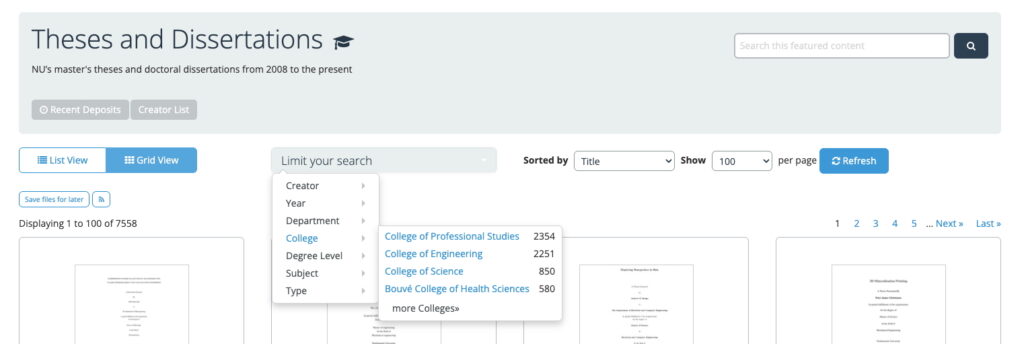
New ETDs are processed and ingested every 2-3 months, depending on the time of year and the volume of ETD submissions, and can involve anywhere from 30 to 100 ETDs at a time. DOIs are generated and ETD contributor names are reviewed bi-annually.
General Growth
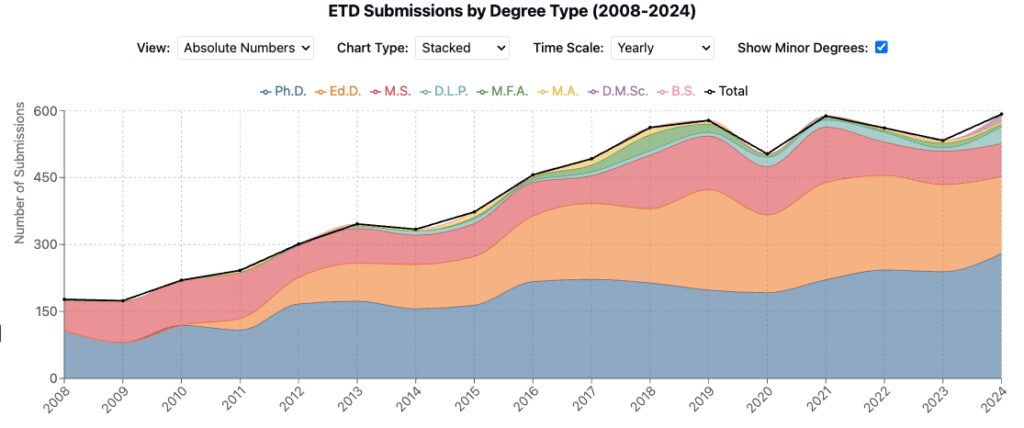
The total number of ETDs submitted by Northeastern students has increased significantly since 2008. From 2008-2010, there was an average of around 190 documents submitted annually. As the 2010s continued, that number steadily increased from 353 in 2013 to 583 in 2019. There was a small dip in 2020, possibly due to COVID interrupting degree completions, but since then, there have been approximately 540-590 ETDs submitted each year.
Degree Distribution
Almost 90% of ETDs produced from 2008-2010 were either for Ph.D. or MS degrees, but as the School of Education started producing theses for the Ed.D. degree, those quickly became common, and represented 34% of all ETDs produced by 2020. Additional degree programs also started producing ETDs from 2010-2020, with MA, DLP, and MFA degrees representing almost 5% of ETDs during that period. In the last 4-5 years, numbers have stabilized, with Ph.D. dissertations regularly accounting for around 45% of all ETDs, Ed.D. theses around 35%, MS theses hovering around 15%, and all other degree types filling out the remaining 5%.
College, School, Department, and Program Representation
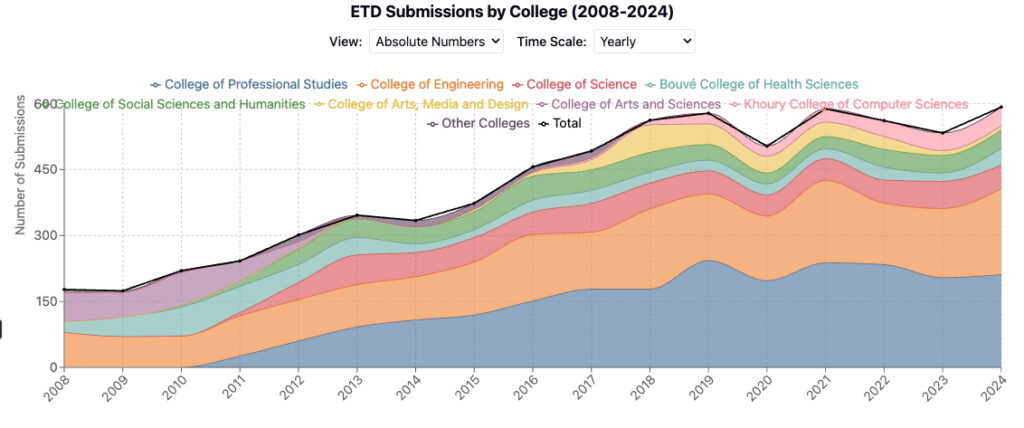
The early majority of ETDs produced by Northeastern students were from the College of Engineering (COE), which accounted for almost 62% from 2008-2010. Throughout the 2010s, other colleges emerged as significant contributors, including the Bouvé College of Health Sciences, the College of Professional Studies (CPS), and the College of Science (COS).
Within the College of Engineering, Electrical and Computer Engineering and Mechanical and Industrial Engineering remain the most prolific ETD producers, as well as the Chemistry and Chemical Biology program, the School of Education, and the Department of Art + Design.
The top 10 departments by total submission count:
- School of Education (2,143 submissions)
- Department of Electrical and Computer Engineering (910)
- Department of Mechanical and Industrial Engineering (705)
- Department of Chemistry and Chemical Biology (316)
- Department of Art + Design (271)
- Computer Science Program (245)
- Department of Civil and Environmental Engineering (242)
- School of Pharmacy (212)
- Department of Chemical Engineering (209)
- Department of Counseling and Applied Educational Psychology (202)
Addition of Supplementary Files
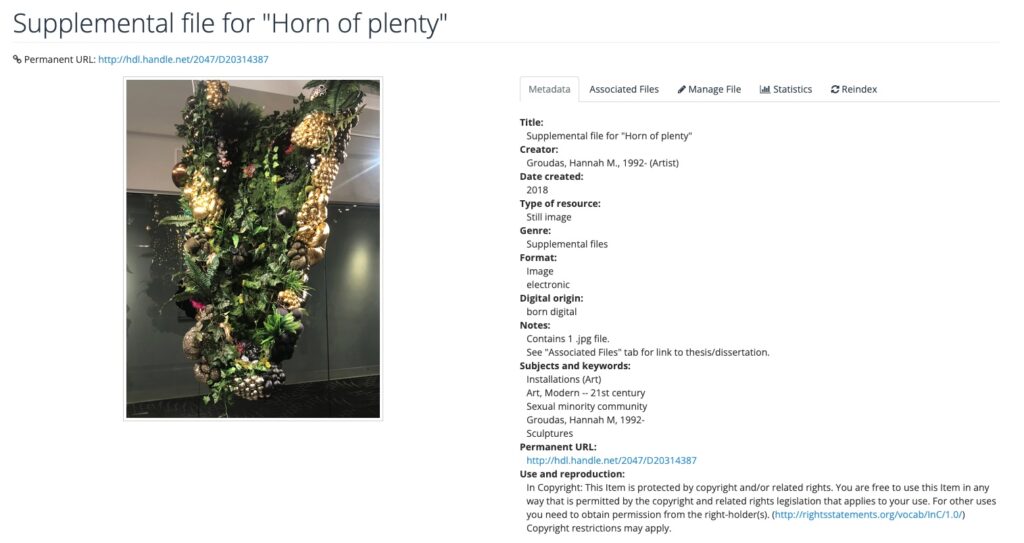
The first ETD to include supplemental files, or files submitted to accompany the ETD PDF file, first appeared in 2013. The number of supplemental files grew throughout the 2010s, with supplemental material representing 4% of all ETD file submissions during that time. Since 2020, the number of supplemental files has seen a slight decline, but there are still regular submissions, with 26 provided in 2024. The college that most often submits these files is the College of Arts, Media, and Design (CAMD), with almost 1 in 4 theses including supplemental materials.
Other notable contributors include COE and the College of Social Sciences and Humanities (CSSH). The smallest contributor is CPS, which, despite being the largest contributor of ETDs overall, has only 11 total supplemental files since 2013.
New Undergraduate Theses
More recently, undergraduate programs from departments like Biology, Biochemistry, Marine and Environmental Science, and Psychology have begun to submit electronic theses directly to DPS staff. DPS offers the same level of service to the undergraduate theses as the graduate ETDs and includes the same metadata in each accompanying description to ensure these materials are as discoverable as the graduate theses and dissertations.
Maintaining ETDs is a vital part of the DRS’ mission, presenting unique challenges that library staff are well-equipped to manage. As the submission processes, file formats, academic disciplines, and research topics continue to evolve, the library remains committed to preserving and providing access to these scholarly works. Through ongoing innovation and stewardship, we ensure that the academic contributions and history of Northeastern students are securely archived and shared for generations to come.
AI acknowledgement: Claude Projects was used to generate data visualizations based on ETD metadata exported from the DRS and transformed into a spreadsheet dataset. Specific visualizations based on identified columns were requested. Project instructions, prompts, and dataset are available here.