Skip to content

Box by Box

Box by Box: Inventorying the Nancy Walker Papers

Since last fall, the processing team has been focused on inventorying unprocessed collections. Inventories allow staff and researchers to learn more about what’s in a collection, help locate materials of interest, and help staff strategize further processing or digitization work, as resources allow. A previous blog post described inventorying the Stull & Lee records. Currently, processing assistants are inventorying more recent donations to the archives. Over the next few months, we will be featuring collections our staff has found particularly interesting to inventory in their own words.

The Nancy Walker Papers

By Samuel Edwards, Processing Assistant

Nancy Walker, Northeastern University Archives and Special Collections.

The Nancy Walker papers, donated to the archives this past year, document the life of lesbian activist and writer/journalist Nancy Walker (1935-1996). Walker was a writer for the Gay Community News, Bay Windows, and the Boston Phoenix, and was a prominent figure in Boston’s LGBTQ+ community from the late 1970s to the ’90s.

Part of what makes this collection fascinating is not just Walker’s own writing, but also her dedication to collecting all manner of LGBTQ+ periodicals and ephemera. Her papers provide a glimpse into the beginning of the gay liberation movement through the eyes of someone who considered herself a political moderate. Her collection is a snapshot of an important time in Boston’s LGBTQ+ history, when the gay rights movement was starting to have real organizing power and institutions like Gay Community News were taking shape.

When I go through the collection, I imagine that I’m Nancy Walker herself, reporting on issues that matter to the gay community that few in the mainstream would cover at that time, and embroiled in a whole mess of loving yet intense intracommunity debate. As someone who has also been involved in LGBTQ+ activism, it strikes me how, in some ways, things have really changed, but in other ways, they haven’t at all!

One item that showcases that complex, interconnected, and exciting social world is the 14th Annual Boston Lesbian & Gay Pride Celebration Calendar of Events, with the iconic Lavender Rhino on the cover. I love these event calendars because it makes it even easier to envision what life was like in this community at the time. It shows many expected social groups and dances, as well as organizations that are still active today, like the Boston Alliance of Gay, Lesbian, Bisexual, and Transgender Youth (BAGLY). However, it also showcases some events you may have never considered, like a Lesbian Whale Watch.
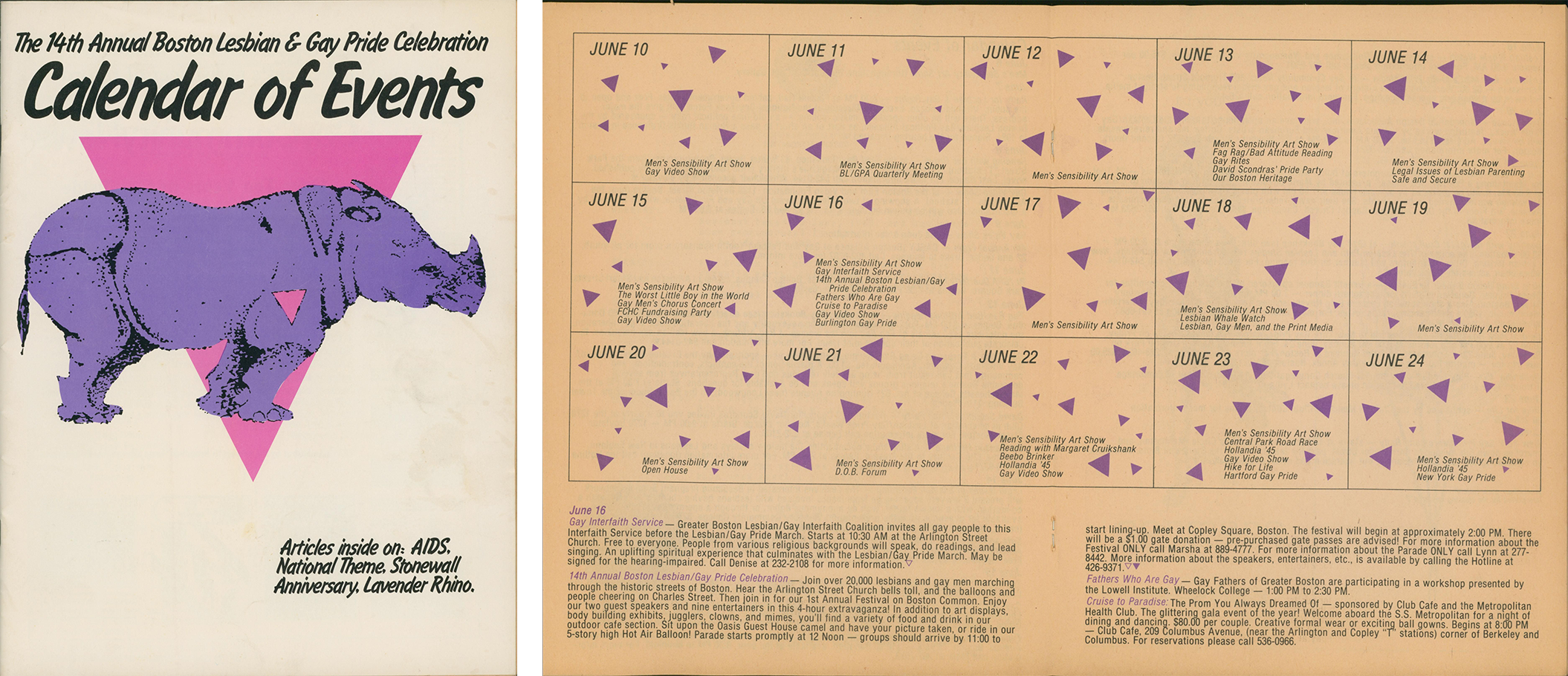
14th Annual Boston Lesbian & Gay Pride Celebration Calendar of Events cover and page, 1984. Nancy Walker papers, Northeastern University Archives and Special Collections.

The collection documents more than just Boston history and Walker’s own identities, and some items showcase unexpected LGBTQ+ history. One example is an article from Back/Chat, a newsletter for the Community Homophile Association of Toronto. It was written in 1974 by Lee Paul Anderson, a trans teenager, and describes some of his experiences and frustration with gender roles. This document reflects the history of trans youth prior to contemporary mainstream media attention.
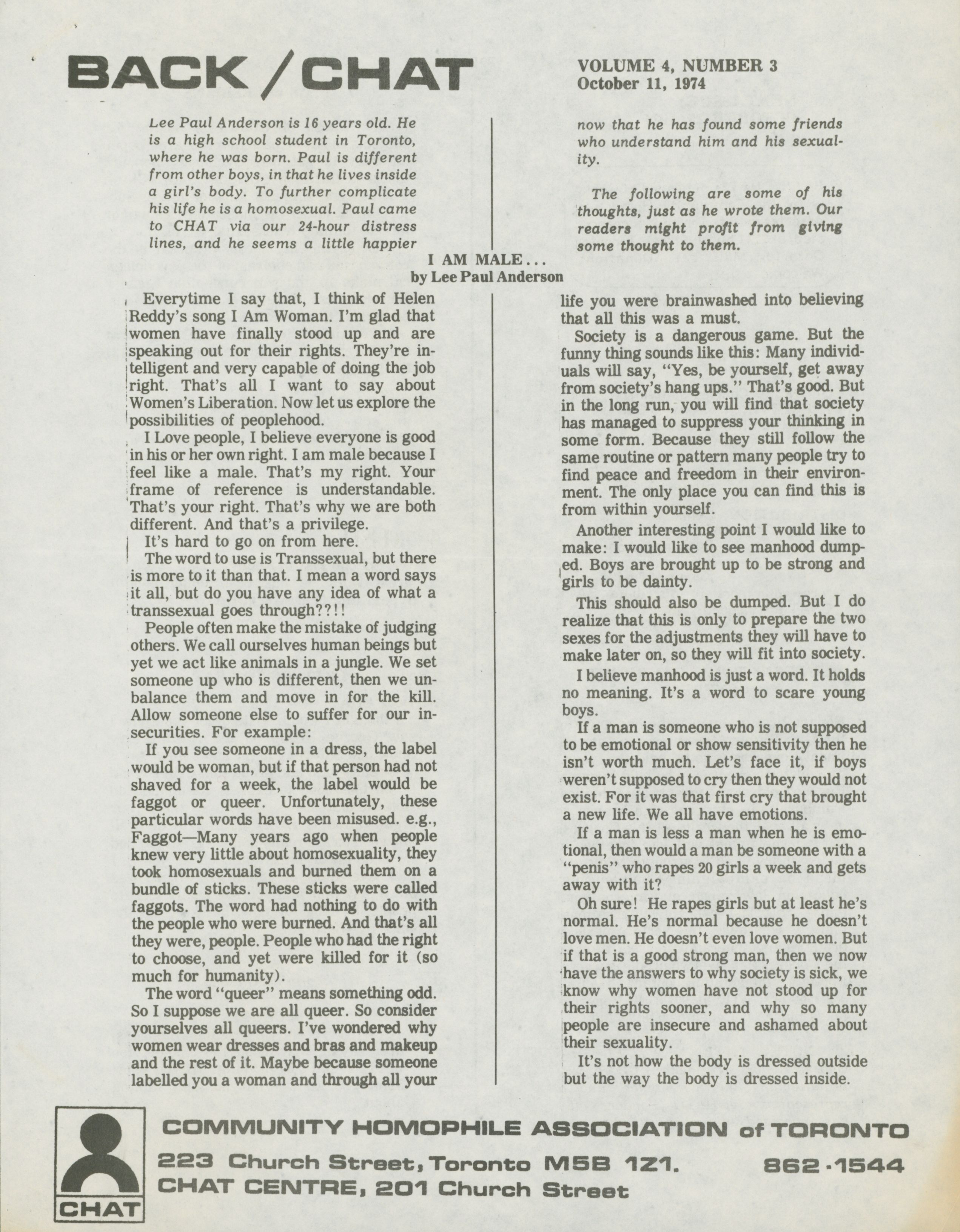
An article from Back/Chat
Back/Chat first page, Volume 4 Number 3, 1974. Nancy Walker papers, Northeastern University Archives and Special Collections.

This collection provides a window not into just Walker’s own life, but what the entire LGBTQ+ scene was like in Boston in the late ’70s, ’80s, and early ’90s. You can also get a glimpse of LGBTQ+ Toronto, as Walker lived there before moving to Boston, a fact that highlights how one individual’s life can be a useful avenue into multiple histories.

If you are interested in LGBTQ+ history both in the general and local sense, I highly recommend giving the Nancy Walker papers a look. While you do, I would also recommend listening to Nancy Walker’s interview with the Making Gay History podcast to learn more about her fascinating life.

Contact the Northeastern University Archives and Special Collections by emailing them at archives@northeastern.edu to find out more about how to view Nancy Walker’s papers.
Box By Box: Inside Archival Processing of the Stull & Lee Records

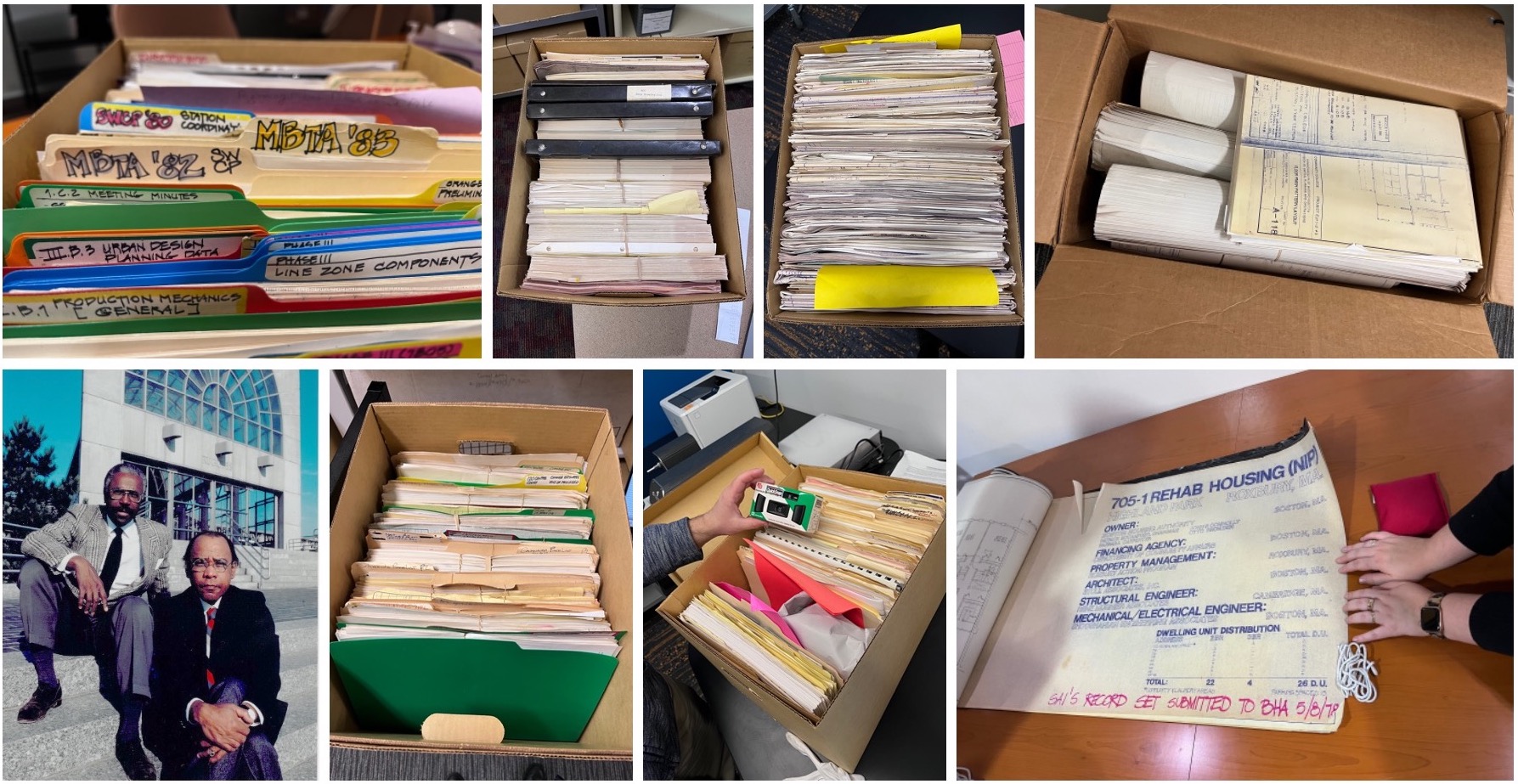
Since October, Northeastern University Archives and Special Collections processing assistants have been inventorying the records of Stull & Lee, a Boston-based architectural and urban design firm founded by Donald Stull in 1966. The firm is still active today, under the leadership of David Lee. The records held by Northeastern date from the 1960s to the early 2000s, spanning over 400 boxes and 700 tubes, and they document hundreds of projects, including the Southwest Corridor, Ruggles Station, and Roxbury Community College. Meet our processing assistants as they go through the collection, box by box.

A collage of images of the Stull & Lee collection, including boxes of documents, blueprints, and an image of two men posing in front of a building
A peek inside the Stull & Lee collection

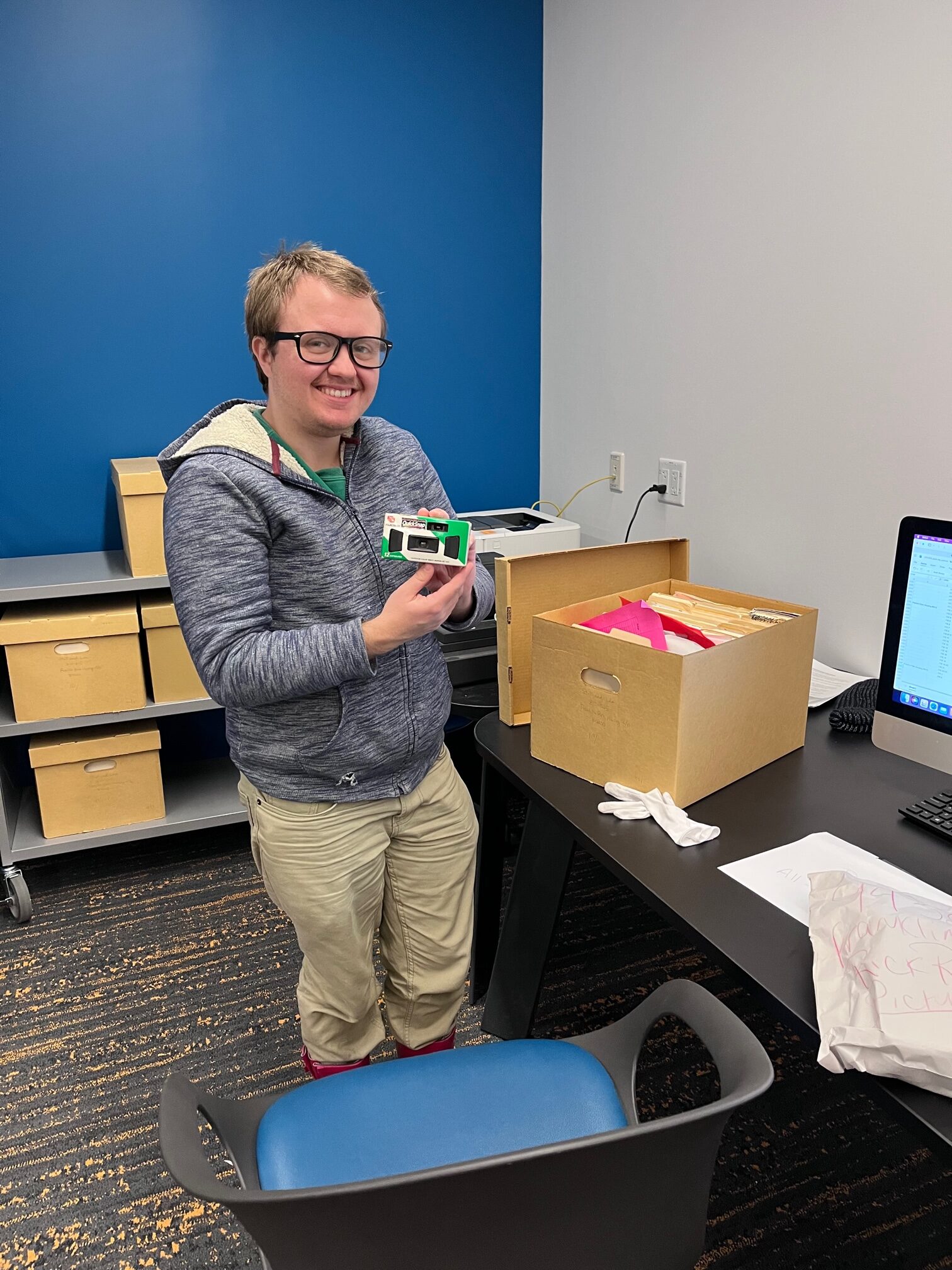
Samuel

A smiling man wearing glasses and a gray hoodie holds a disposable camera while standing in front of an archival box

I’m Samuel Edwards (he/him). I just completed my Master of Arts degree in Library and Information Science with a concentration in Archives Management at Simmons University, and I have a Bachelor of Arts in History and Playwriting from Hampshire College in western Massachusetts. Some of my interests in archives include the history of social movements, LGBTQ+ history, local history, and anti-racist archival work. Outside of my archival work, I enjoy creative writing, theater, and playing Dungeons & Dragons with my friends.

Working on the Stull & Lee records has been an enlightening experience. I didn’t have a lot of familiarity with architecture or architectural records prior to working on this collection, but it’s fascinating to realize how much goes into creating just one building. You don’t just have the architects, but also electricians, plumbers, and other trades that help create the building. I have a newfound appreciation for buildings that previously just blended into the background, especially the buildings I walk by daily on my way to Northeastern which were designed by Stull & Lee, such as Ruggles Station.

Julia

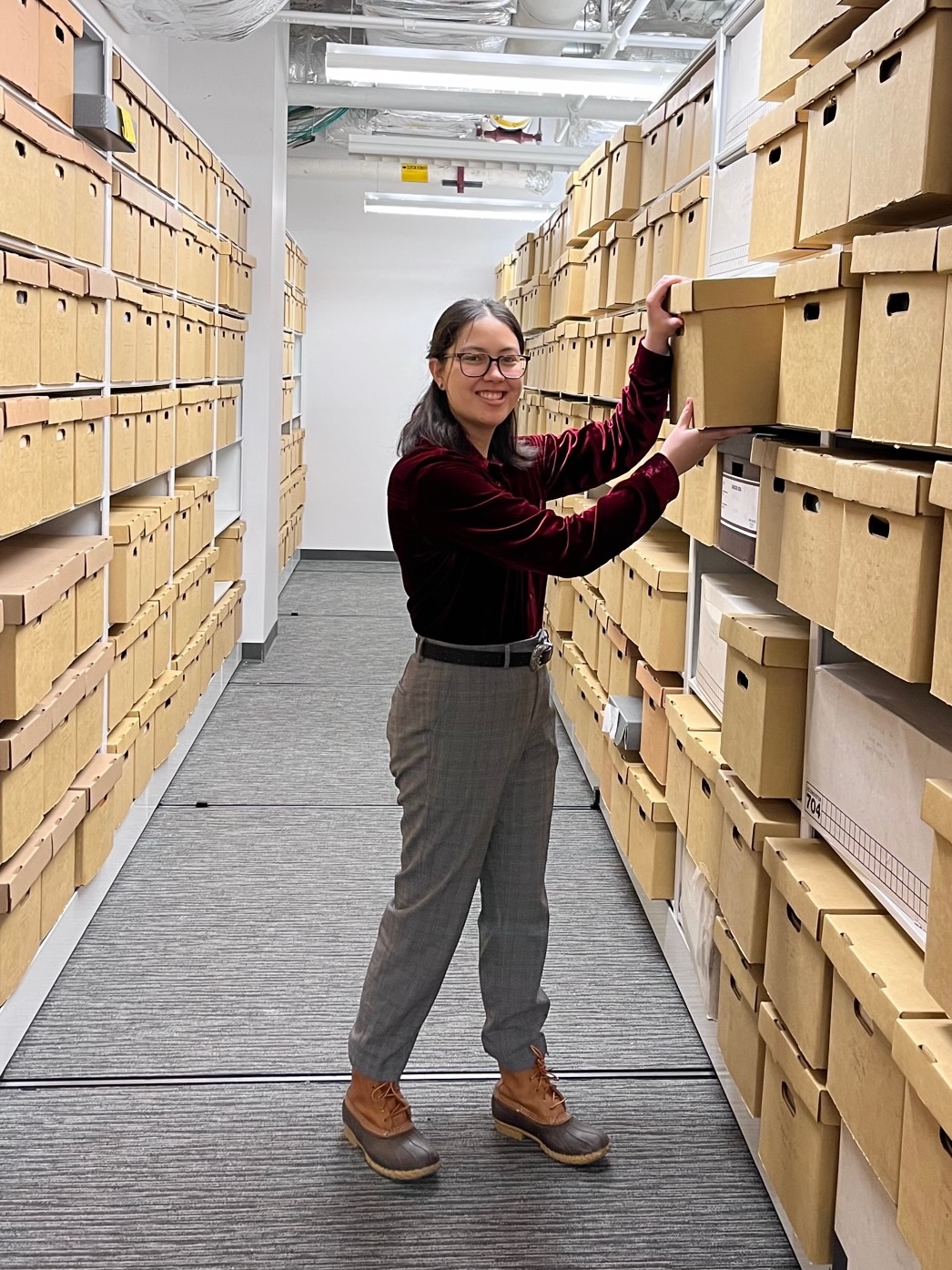
A smiling woman with glasses and a red shirt pulls a box from a shelf

I’m Julia Lee (she/her). I recently graduated from Northeastern University with a Bachelor of Arts in English and Theatre, and my final co-op was as a digital assistant for the Massachusetts Archives. My archival interests include early American history, including the Revolutionary War, Asian-American history, and the history of Boston.

For me, working with the Stull & Lee records started with inventorying boxes of files belonging to several architects, including the firm’s namesakes Donald Stull and David Lee. It turns out that the two men had quite distinct organizational styles. While several of Lee’s folders included colorful titles patterned after the T’s Orange Line signs, Stull favored concise alphabetization for his files. I’ve enjoyed the greater understanding I’ve gained of Boston’s architecture, transit, and public works through working with the collection, especially about the area around Northeastern, where I’ve lived for over four years now. This is my second time working in an archive, and it has served to solidify my goal of obtaining a Master’s degree in Library and Information Science in the coming years.

Aleks

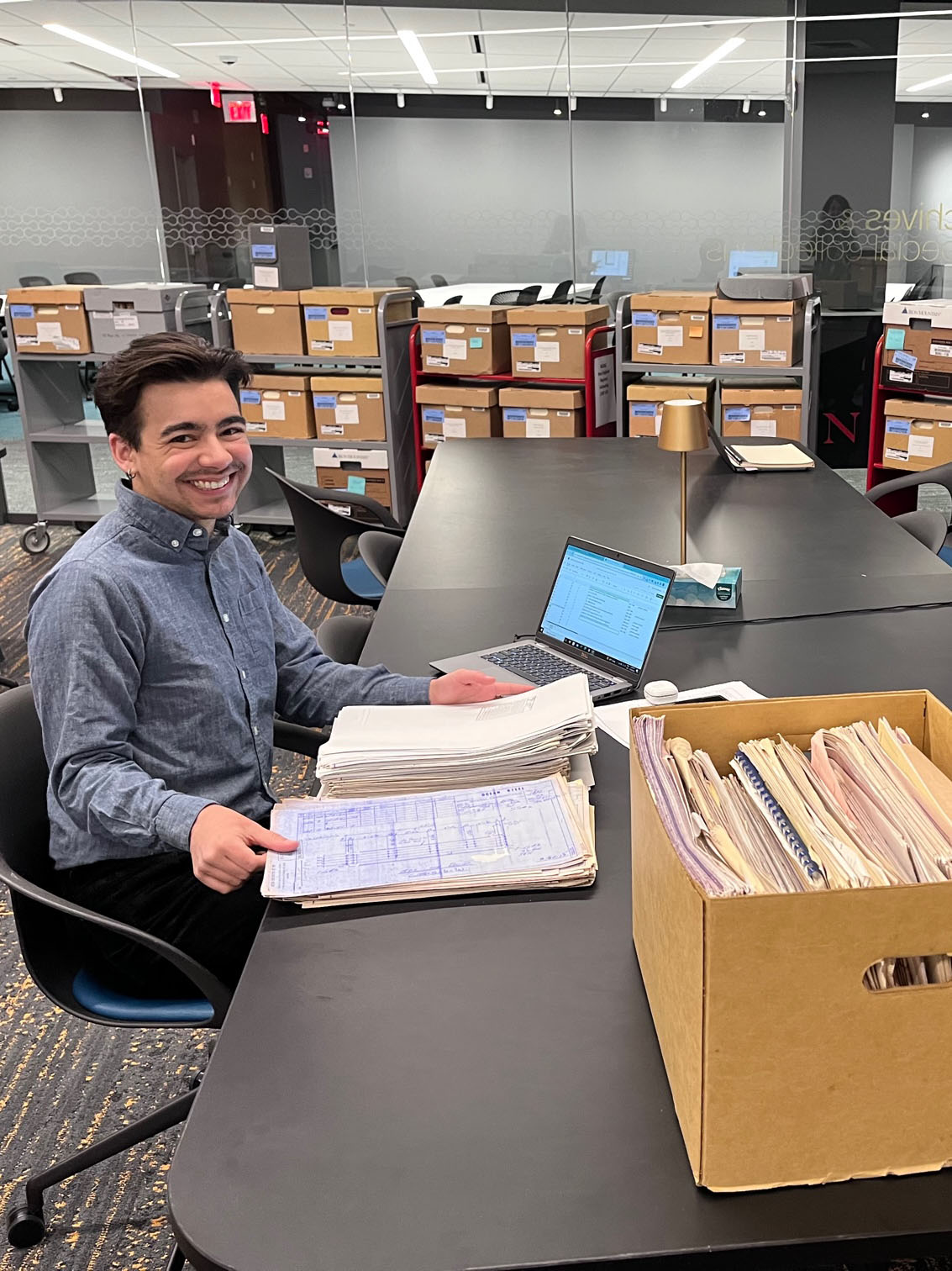
A smiling man sits at a table with a laptop and a stack of documents, surrounded by archival boxes

I’m Aleks Renerts (he/him). I am a current graduate student at Simmons University in the dual Master of Arts degree program in History and Library and Information Science, with a concentration in Archives Management. My academic background is in history, with a focus on the Hispanic world and histories of class, gender, and colonialism. I received my Bachelor of Arts in History from McGill University, and have since partially redirected my focus to archives and archival research.

Something I’ve found interesting in the Stull & Lee records is the massive degree of collaboration that every architectural project depends on. Memos, notes, letters, logs, and drawings are sent back and forth with revisions, showing the complex process that goes into completing a project. There’s an incredible level of detail for all the parts of a completed structure, from steel framing and floor tiles to the mechanics of a door lock. Working on Stull & Lee has given me an appreciation of just how much detailed work goes into every part of constructing a building.